The Fiber Gap: Why 95% of Americans Fall Short
You already know fiber is good for you. Your doctor has probably mentioned it. The back of every cereal box tells you about it.
And yet, according to the USDA's own dietary data, only 5% of American adults actually hit their daily fiber target.
Not 50%. Not 25%. Five percent.
The recommended daily intake is 25 grams for women and 38 grams for men. The average American consumes roughly 15 grams. That leaves a daily shortfall of 10 to 23 grams, depending on your age and sex.
This is not a niche problem affecting people with poor diets. This is a structural issue with the modern food supply. Processed foods, refined grains, and convenience meals have had their fiber systematically stripped out over the past 50 years. Even people who consider themselves healthy eaters typically land between 16 and 18 grams, still 7 to 22 grams below the target.
The gap is not about willpower. It is about math.
How Much Fiber You Actually Need (By Age and Sex)
Here are the USDA Dietary Guidelines for daily fiber intake, broken down by age group and sex.
| Age Group | Women | Men |
|---|---|---|
| 19-30 | 28g | 34g |
| 31-50 | 25g | 31g |
| 51+ | 22g | 28g |
| Pregnant | 28g | N/A |
| Breastfeeding | 29g | N/A |
The general targets most cited: 25g for women, 38g for men. The 38g male target is the FDA Daily Value based on a 2,000-calorie reference diet. The age-specific USDA ranges in the table above are slightly lower. Both sets of numbers come from federal dietary guidelines.
For context, 25 grams of fiber looks like eating all of these in a single day: 1 cup of lentils (15.5g), 1 medium pear (5.5g), and 1 cup of broccoli (5.1g). That is achievable on paper. In practice, it requires deliberate meal planning that most people do not sustain beyond a few weeks.
The real question is not "how much do I need?" It is "how much am I actually getting?"
Think about what you ate yesterday. Count the fruits, vegetables, legumes, and whole grains. If it was fewer than 5 servings of high-fiber foods, you are almost certainly below 20 grams.
What Happens When You Don't Get Enough
The fiber gap is not just an abstract nutrition number. Insufficient fiber intake has measurable downstream effects on multiple body systems.
Digestion
Fiber adds bulk to stool and feeds the bacteria that keep your gut lining healthy. Without adequate fiber, transit time slows, constipation becomes more frequent, and the microbial diversity in your gut declines. Registered dietitians consistently identify low fiber as the single most common dietary deficiency they see in clinical practice.
Blood Sugar
Soluble fiber slows the absorption of carbohydrates, reducing post-meal glucose spikes. When fiber intake is chronically low, blood sugar swings become more pronounced. You feel it as the 2:30 pm energy crash, the mid-morning hunger that hits an hour after breakfast, the brain fog that settles in after lunch.
Cholesterol
Multiple clinical studies have demonstrated that soluble fiber binds to cholesterol particles in the digestive system and helps remove them. The FDA allows a health claim for soluble fiber and reduced risk of heart disease because the evidence is that strong. When your doctor tells you your LDL is "creeping up," fiber is one of the first-line dietary interventions.
Fullness and Weight
Soluble fiber forms a gel that slows digestion; insoluble fiber adds bulk and delays gastric emptying; protein provides long-lasting fullness. People who consistently hit 25+ grams of fiber per day report eating less at subsequent meals without conscious calorie restriction.
Microbiome Health
Your gut bacteria need fiber as fuel. Specifically, they ferment soluble fiber into short-chain fatty acids (SCFAs), which nourish the gut lining, regulate immune function, and have been linked to improvements in mood and cognitive function. Low fiber starves these bacteria. Over time, microbial diversity drops, and the bacteria that thrive on sugar and processed food take over.
The Food Math Problem: Why Eating Your Way There Is Harder Than You Think
Let's do the math on what 9-18 grams of additional fiber looks like from whole foods alone. That range matters because it is the gap between the average American intake (15g) and the female RDA (25g) up to the male RDA gap.
The black beans and chia seeds show it is technically possible to close the gap from one food. But nobody eats 1.2 cups of black beans or 3.5 tablespoons of chia seeds every single day for a year.
The real challenge is consistency, not capability. You can eat any of these amounts on a given Tuesday. You will not do it 365 days in a row.
This is the core of the fiber gap. The modern diet makes it structurally difficult to hit 25-38 grams from food alone without significant planning, preparation, and repetition. The people in the 5% who do hit it tend to be those who already prioritize cooking from scratch with legumes, whole grains, and large volumes of vegetables as daily staples.
For the other 95%, the math simply does not work with how most people eat.
The 30-Day Fiber Timeline: What Changes When You Close the Gap
What actually happens in your body when you go from the American average of 15 grams to a full 25-38 grams? Here is what the clinical literature and real-world experience suggest.
"Two weeks in, I'm more regular than I've been in years."
Rachel M., Verified BuyerThe timeline is not overnight. But the compounding nature of consistent fiber intake means that the longer you sustain it, the more pronounced the benefits become. Most people report feeling meaningfully different by the end of week three.
3 Ways to Close the Gap (Food, Supplement, or Both)
If you are in the 95%, you have three realistic paths to closing your fiber gap.
Food-First Approach
Add 5-7 servings of high-fiber foods daily. Focus on legumes (lentils, black beans, chickpeas), whole grains (oats, quinoa, barley), vegetables (broccoli, artichoke, Brussels sprouts), and fruit (raspberries, pears, avocado).
Pros: Whole foods bring vitamins, minerals, and phytonutrients alongside fiber. No supplements needed.
Cons: Requires meal planning, prep time, and consistent execution. Most people sustain it for 2-3 weeks before reverting to old habits.
Supplement-Only Approach
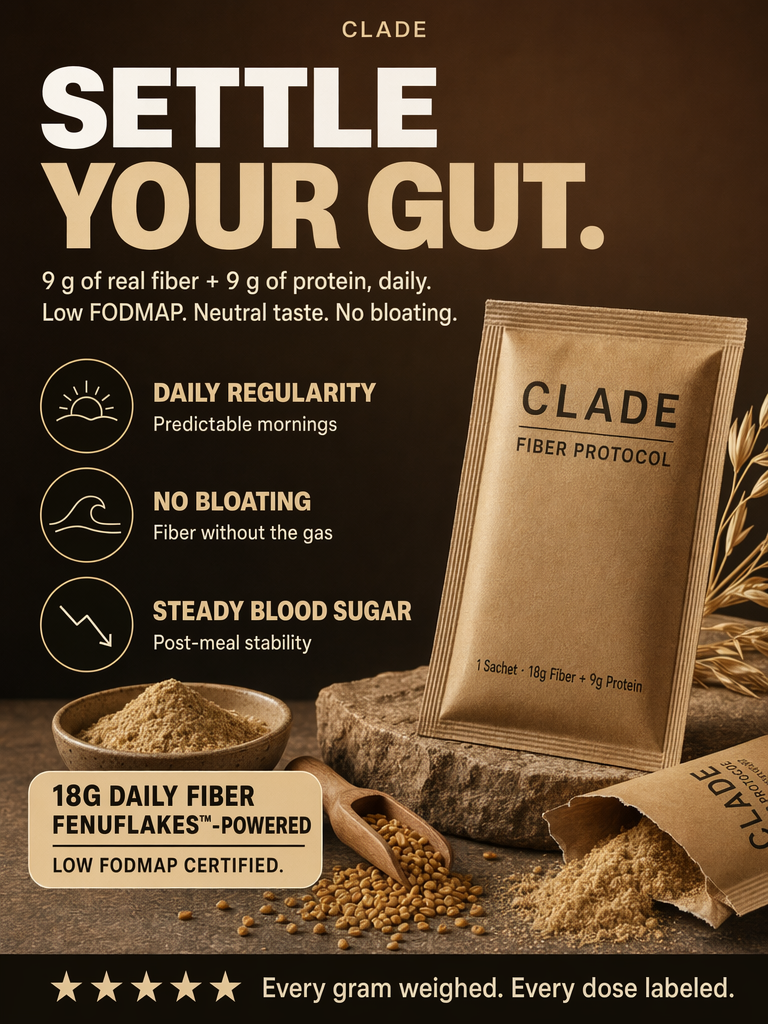
Use a fiber supplement to cover your daily gap. Options range from psyllium husk (Metamucil) to newer options like Supergut, Bellway, and CLADE.
Pros: Convenient, consistent, no meal planning required.
Cons: Supplements vary enormously in fiber content per serving, taste, digestive tolerance, and quality. Most deliver only 2-6 grams per serving.
Food + Supplement (The Practical Path)
Eat the fiber-rich foods you already enjoy without forcing new habits, and use a supplement to bridge the remaining gap.
This is how most registered dietitians advise their patients. You get the micronutrient benefits of whole foods while ensuring you consistently hit your daily target regardless of what any individual meal looks like.
A realistic example: If your normal diet provides 12-15 grams of fiber and you supplement with 9 grams of fiber + 9 grams of protein per day at a 1:1:1 ratio (like CLADE), you land at 21-24 grams of fiber plus meaningful plant protein. Close the rest of the gap with a serving of black beans or a cup of raspberries, and you'll clear the female RDA without any dramatic dietary changes.
At this point, you have a complete picture. You know how much fiber you need, what happens when you fall short, why food alone is difficult to sustain, and your three options for closing the gap. If you are ready to explore the supplement path, keep reading.
Key Takeaways So Far
- 95% of American adults fall short of the USDA fiber recommendation (25-38g/day)
- The average intake is 15g, leaving a 10-23g daily gap
- Closing that gap from food alone requires 7 cups of broccoli or 4 apples every day
- Most dietitians recommend food + supplement as the most sustainable approach
- Benefits compound over 30 days: regularity, stable energy, improved cholesterol markers