Research · 9 min read

The GLP-1 Revolution Missed the Oldest Metabolic Signal. It Was in Your Fiber All Along.

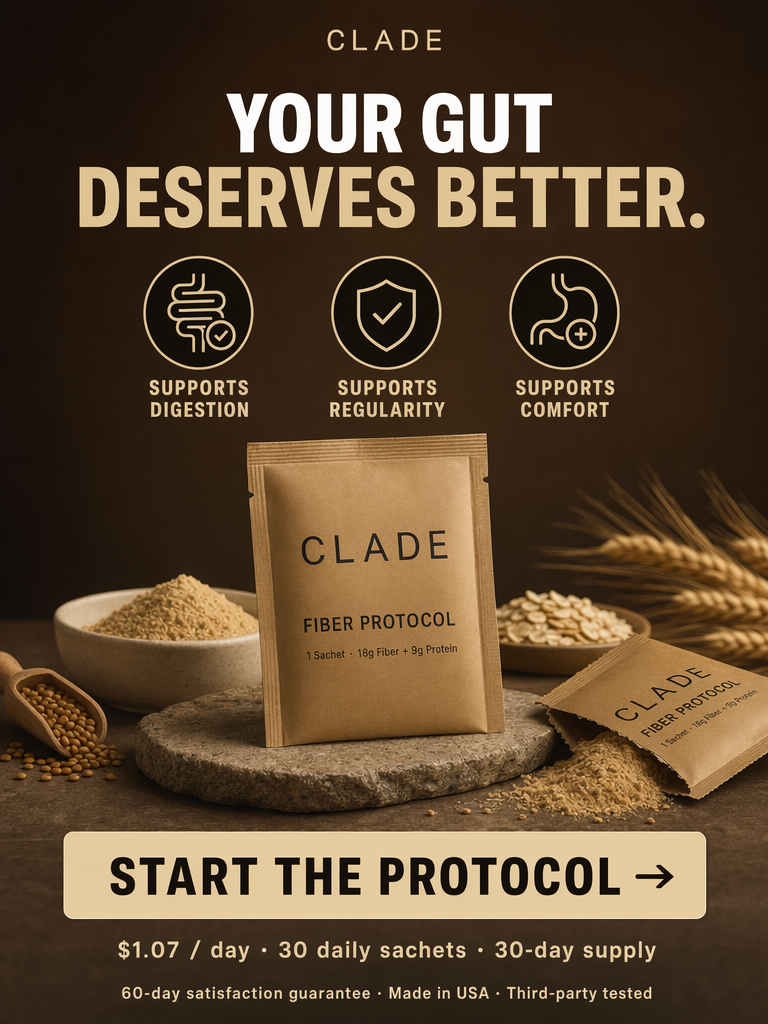
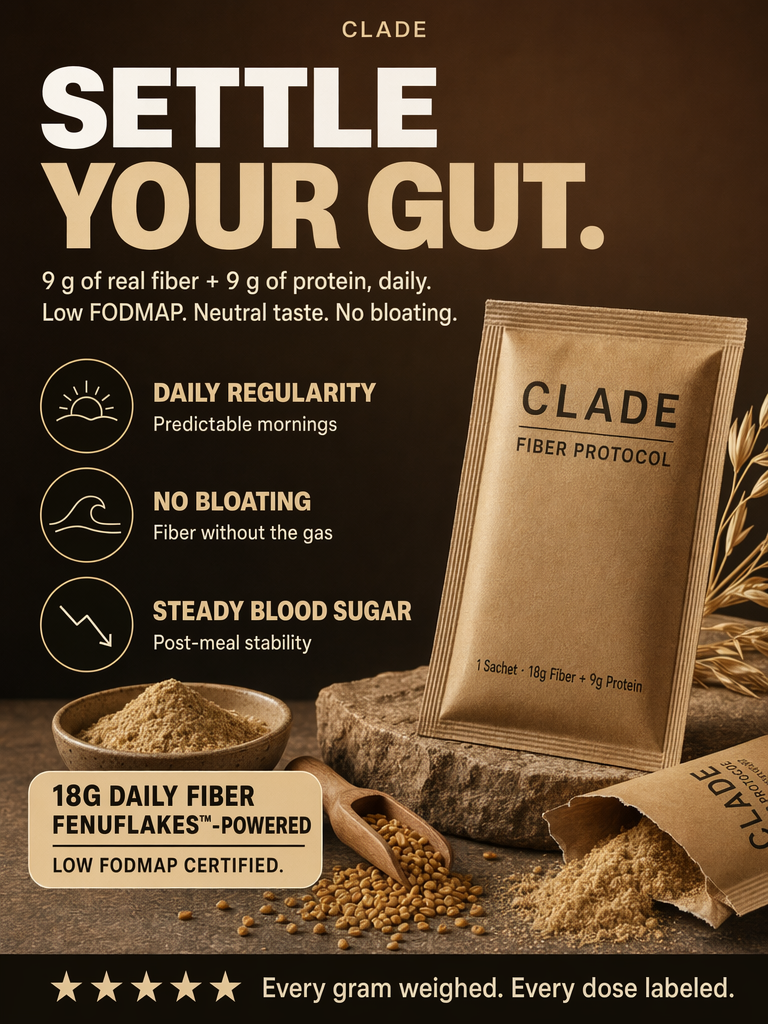
While the world chased GLP-1 drugs, published research quietly showed that soluble fiber supports the same hormone naturally. The problem: meaningful doses matter. CLADE delivers 18g fiber + 9g protein per day at a 1:1:1 ratio. Most supplements give you 2g.

CLADE™ Fiber Protocol jar for GLP-1 weight management support
4.8 from 892 Verified Reviews
LOW FODMAP Certified
90-Day Money-Back Guarantee
18g Fiber + 9g Protein (1:1:1)
Clinically Studied Fenuflakes

How Fiber Supports GLP-1 (The Mechanism Nobody Talks About)

When soluble fiber reaches your large intestine, gut bacteria ferment it into short-chain fatty acids (SCFAs), primarily butyrate, propionate, and acetate. These SCFAs bind to free fatty acid receptors (FFAR2 and FFAR3) on intestinal L-cells.

Those L-cells are the same cells that GLP-1 drugs target. The same cells that produce the GLP-1 hormone involved in appetite regulation and insulin secretion.

The mechanism has been published in journals including Cell Metabolism, Nature Reviews Endocrinology, and Diabetes Care. It is not theoretical. It is established physiology.

Here is the part the supplement industry conveniently ignores: meaningful SCFA production requires meaningful fiber intake. Not 2g (Metamucil). Not 5g (Bellway). Not even 6g (Supergut).

Published research on SCFA production shows dose-dependent effects. The more soluble fiber reaching your colon, the more SCFAs produced, the stronger the L-cell signaling. The studies that demonstrated significant metabolic effects used fiber intakes of 15-30g daily.

And 95% of Americans get less than 15g total. Most get 10-12g.
The Dose Problem No One Wants to Discuss

Supergut renamed their fiber product "GLP-1 Daily Support." Bold claim. Their fiber dose: 6g per day.

Metamucil ran Amazon listings calling their product "GLP-1 Friendly Fiber." Their fiber dose: 2.4g per day.

Both of these products contain fiber. Both technically contribute to SCFA production. But 2.4g or 6g of fiber producing enough SCFAs to meaningfully support L-cell signaling? The published dose-response data doesn't support that conclusion.

This is a common pattern in the supplement industry: take a real mechanism (fiber → SCFAs → L-cell signaling), deliver a fraction of the dose the research used, and claim the benefit.

The USDA recommends 25-38g of fiber daily. The average American gets 15g from food. That's a 10-23g gap. Closing it with a supplement that delivers 2-6g is like trying to fill a swimming pool with a teaspoon.

18g of Fiber. 9g of Protein. 1:1:1 Ratio. One Ingredient.

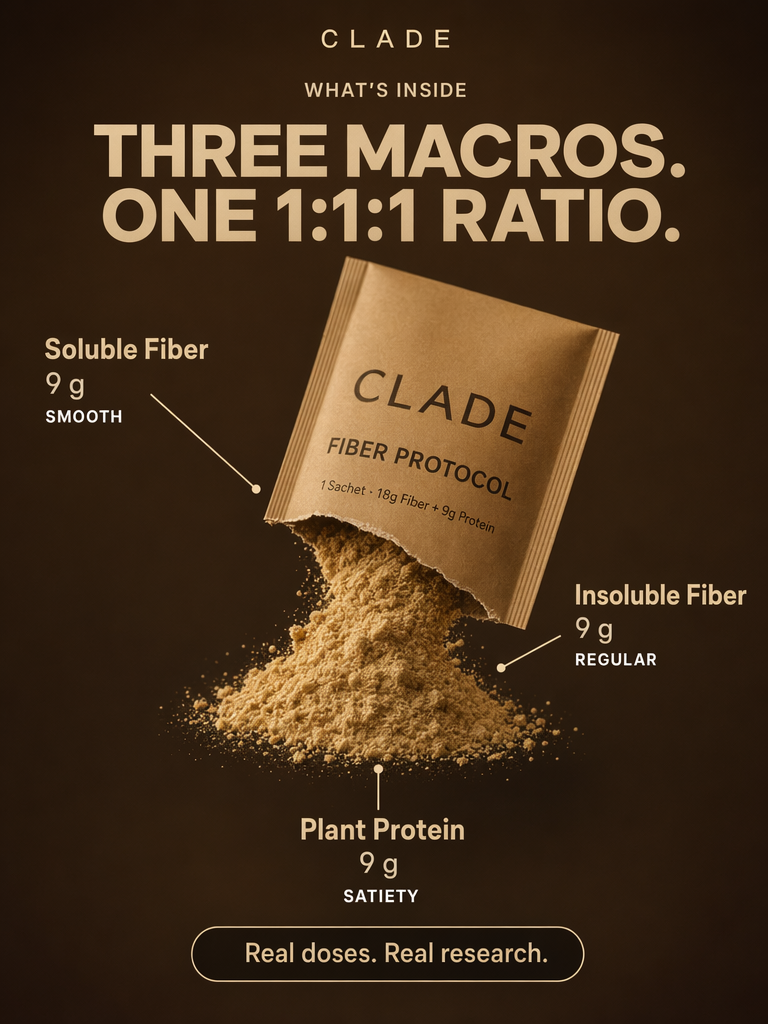
CLADETM Fiber Protocol delivers 18g of fiber plus 9g of plant protein per day at a 1:1:1 ratio from Fenuflakes, a branded fenugreek fiber built on an equal 1:1:1 ratio — 9 g soluble fiber + 9 g insoluble fiber + 9 g protein per day.

One scoop per day. Stir it into food or a drink, with a meal. Mixes well with any food — smoothies, oatmeal, yogurt, soups, even coffee. Neutral taste that disappears in any meal.

Here's why the dose and ratio matter for natural GLP-1 pathway support:

18g of fiber at a 1:1:1 soluble : insoluble : protein ratio = substantially more SCFA production than 2-6g of mixed fiber. The relationship is dose-dependent. Published research on fiber fermentation kinetics shows that increasing soluble fiber intake scales SCFA output — and CLADE's 9 g of dedicated soluble fiber per day is a meaningful daily substrate.

This means CLADETM's 1:1:1 profile supports more SCFAs reaching FFAR2/FFAR3 receptors on L-cells than Supergut's 6g or Metamucil's 2.4g.

9g of plant protein works alongside. Protein slows gastric emptying, which extends the time fiber spends in the GI tract being fermented into SCFAs. The combination of balanced fiber plus protein supports long-lasting fullness more effectively than fiber alone. The protein also carries a full spectrum of amino acids — all essential amino acids included.

And the protein isn't added. It's intrinsic to Fenuflakes. One ingredient doing two jobs.

LOW FODMAP certified by Monash University. For anyone with IBS or FODMAP sensitivity, this matters. Fenuflakes does not contain only easily fermentable carbohydrates — so the fiber in CLADETM doesn't cause the bloating, gas, and cramping that psyllium (Metamucil) and inulin-based fibers trigger in sensitive stomachs. The Monash certification removes the guesswork.

Fenugreek seeds and Fenuflakes powder supporting GLP-1 production via SCFA pathway
Fenuflakes™ — 1:1:1 soluble : insoluble : protein (9 g of each per day), one ingredient for the SCFA-GLP-1 pathway

GLP-1 Fiber Supplements: Dose Comparison

CLADE™ Fiber Protocol Supergut "GLP-1 Daily Support" Metamucil "GLP-1 Friendly"
Fiber per day 18g (9g soluble + 9g insoluble, 1:1:1 with 9g protein) 6g 2.4g
Protein per day 9g 0g 0g
Fiber dose (more soluble fiber = more SCFAs) 18g with 9 g dedicated soluble per day 6g 2.4g
LOW FODMAP Certified Yes (Monash) Yes (Low FODMAP) No
Primary fiber type Fenugreek soluble (60%) Resistant starch (Solnul) Psyllium husk
GI side effects (IBS risk) Low Low-Moderate High (bloating, cramping)
Neutral taste Yes No (flavored) No (flavored)
Price/month (subscription) $35 $40-48 $4.50
Fiber per dollar 0.51g/$1 0.15g/$1 0.53g/$1
Published GI-lowering data Yes (Fenuflakes) Yes (Solnul RCT) General psyllium data

Close Your Fiber Gap With the Only Supplement That Delivers 18g fiber + 9g protein at a 1:1:1 ratio

You've seen the dose comparison. Here's how to get 3x more fiber than any competitor.

Get 3x More Fiber →

90-Day Guarantee • Free Shipping on Subscriptions • $1.17/day

The Honest Truth About Fiber and GLP-1

We need to say this clearly: fiber is not Ozempic. No supplement is.

GLP-1 receptor agonist drugs inject a synthetic peptide that directly activates GLP-1 receptors at pharmaceutical concentrations. Fiber supports natural GLP-1 production through SCFA-mediated L-cell signaling. These are different mechanisms operating at different magnitudes.

Fiber will not produce the dramatic weight loss that semaglutide produces. That's not what it does.

What published research does support: adequate fiber intake (25-38g daily) is associated with healthier postprandial glucose responses, long-lasting fullness through the day, and better metabolic markers over time. These are incremental, sustainable improvements. Not pharmaceutical-grade interventions.

If you need GLP-1 drug therapy, talk to your doctor. CLADETM is not a substitute.

But if you're in the 95% of Americans not getting enough fiber, and you want to support your body's natural appetite and metabolic regulation through the single most evidence-backed dietary intervention, this 1:1:1 fiber + protein profile is a meaningful step toward closing the gap.

What to Expect When You Close the Fiber Gap

Week 1: Digestive Adjustment

Your gut microbiome is adjusting to significantly more soluble fiber. Regularity improves. Some users notice mild changes in digestion as SCFA production ramps up. This is normal and subsides.

Weeks 2-3: Fullness Shifts

Appetite between meals begins to normalize. The 3pm snacking urge softens. Soluble fiber forms a gel that slows digestion; insoluble fiber adds bulk and delays gastric emptying; protein provides long-lasting fullness — the 1:1:1 ratio means you are getting all three together in every scoop.

Week 4+: Metabolic Consistency

Blood sugar stability improves. Postprandial glucose spikes flatten. Energy through the day becomes more consistent. Users with CGMs start seeing cleaner glucose curves.

Month 2-3: Sustained Fiber Sufficiency

You've started closing the fiber gap your body has been running for years. The cumulative effects of adequate SCFA production, steady fullness between meals, and improved glucose metabolism compound. This is why the 90-day plan exists.

What Happens When You Close the Fiber Gap

"I looked into Ozempic but my doctor said my BMI didn't qualify. She suggested starting with fiber. I was getting maybe 11g from food. Adding CLADETM's daily scoop brought me to 29g. Within three weeks, I stopped snacking after dinner. Not through willpower. The craving just wasn't there."

Nicole R., 44

★★★★★

"I was skeptical that fiber could affect appetite. I'm a registered dietitian and I should have known better. The SCFA-GLP-1 pathway is well established. What surprised me: my own between-meal fullness improved noticeably within the first two weeks. 9g at a 1:1:1 ratio with 9g of protein is a meaningful daily dose. Most of what I'd been recommending to patients was 3-6g of fiber alone."

Dr. Hannah M., RD, 39

★★★★★

"Replaced my morning protein shake with a CLADETM scoop in oatmeal. Same prep time. 18g fiber plus 9g protein at a 1:1:1 ratio I wasn't getting before. Two months in, my blood sugar stability is measurably better on my CGM."

Vincent T., 51

★★★★★

"Supergut was fine but 6g of fiber wasn't closing my gap and came with no protein. I was still hungry between meals. Switched to CLADETM's 18g fiber + 9g protein at a 1:1:1 ratio and the difference was obvious within the first week. One scoop, zero taste, and I actually feel satisfied after eating."

Pamela D., 47

★★★★★

These are individual results. Your experience may differ. CLADETM is a dietary supplement, not a medication.

The Cost of Closing the Fiber Gap

CLADETM Fiber Protocol costs $35/month on the 90-day plan. That's $1.17 per day for 18g of LOW FODMAP certified fiber and 9g of plant protein at a 1:1:1 ratio, with a full spectrum of amino acids.

For reference:

The one-time purchase price ($55/month) is higher. We designed the subscription to reward consistency because the metabolic benefits of sustained fiber intake are cumulative. The 90-day plan reflects that biology.

Every subscription ships free. Every purchase is backed by a 90-day money-back guarantee.

CLADE™ Fiber Protocol 90-day supply for sustained GLP-1 support

Frequently Asked Questions

Does this fiber cause bloating?

CLADETM Fiber Protocol is LOW FODMAP certified by Monash University, the global authority on FODMAP research. Unlike psyllium (Metamucil) and inulin-based fibers that ferment rapidly and cause gas, Fenuflakes uses a 1:1:1 blend of soluble fiber, insoluble fiber, and protein that ferments gradually and does not contain only easily fermentable carbohydrates. Most IBS patients report no bloating. The LOW FODMAP certification exists specifically to give sensitive stomachs confidence.

Can I take this with GLP-1 medications?

CLADETM Fiber Protocol is a dietary fiber supplement, not a GLP-1 drug. Fiber is generally recommended alongside GLP-1 medications to support digestive health. However, always consult your prescribing physician before adding any supplement to a medication regimen.

Why not just eat more fiber from food?

You should. Food-first is the right principle. But closing a 10-23g fiber gap from food alone requires large daily volumes of broccoli, beans, or apples — most people cannot sustain that. CLADETM closes 18g of that gap (plus 9g of plant protein) in one tasteless daily scoop you stir into food you already eat.

What does it taste like?

Nothing. Fenuflakes has a neutral flavor profile that disappears in smoothies, oatmeal, yogurt, soups, and even coffee. It does not thicken liquids the way psyllium does. No artificial flavoring, no sweeteners.

The CLADETM Protocol Promise

Try 18g of daily fiber plus 9g of plant protein at a 1:1:1 ratio for 90 days. If your between-meal fullness and digestive regularity don't improve meaningfully, we refund every dollar. No forms. No questions.

  • 90-Day Risk-Free Trial
  • Full Refund, No Questions
  • LOW FODMAP Certified for Sensitive Stomachs

18g Fiber + 9g Protein at a 1:1:1 Ratio. $1.17/Day. 90-Day Guarantee.

Get 3x More Fiber Than Any Other Supplement →

LOW FODMAP Certified • Free Shipping on Subscriptions • Starts at $1.17/day

*These statements have not been evaluated by the Food and Drug Administration. This product is not intended to diagnose, treat, cure, or prevent any disease. Fiber supports natural GLP-1 production through SCFA-mediated mechanisms; it does not replicate the pharmacological action of GLP-1 receptor agonist drugs.*

4.8 • 90-Day Guarantee
Get 3x More Fiber →